
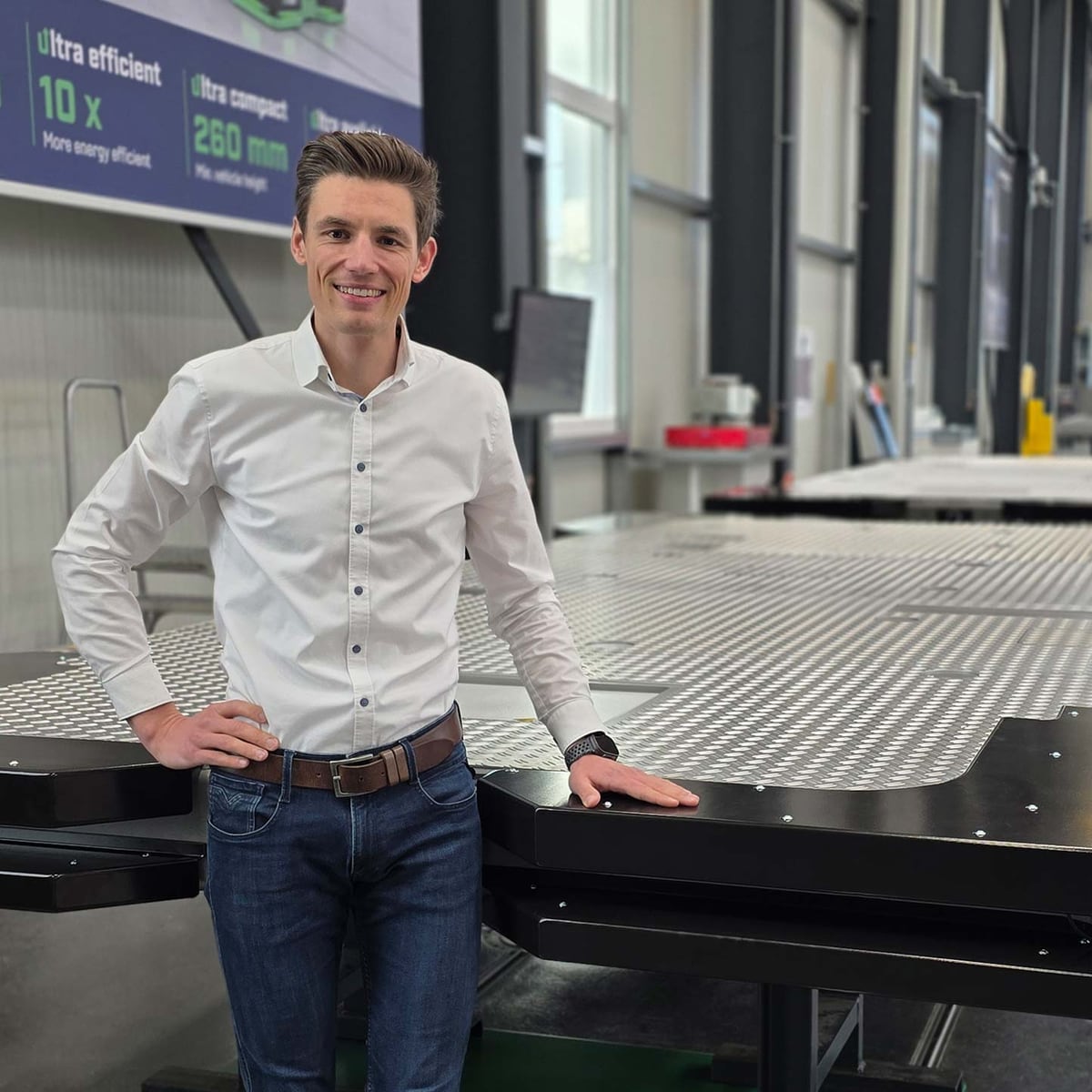
uTrack is the AGV system for automated material transport of loads from 5 to 200 tons. Thanks to the uTrack guided track system, even extremely long and wide loads can be moved precisely and safely. Its optimal field of application is pre- and final assembly, for example in the production of commercial vehicles, agricultural machinery, or energy storage systems. For many production planners, however, the key question remains: At what point does the use of an AGV system in assembly lines become economically viable? Maximilian Michels, Sales Director at SIEMPELKAMP Transport Systems, provides an overview of the key decision-making criteria.
Interview with Maximilian Michels, Sales Director, SIEMPELKAMP Transport Systems
Depending on the production process, different conveying techniques make sense. Too much or too little flexibility reduces production efficiency and, conversely, increases costs. Rigid systems can no longer keep up with current trends toward increased product variance or shorter product life cycles. Completely free-running systems, on the other hand, are very costly and this feature often cannot be implemented in practice in a meaningful way. Our experience has shown that uTrack reflects the characteristic of optimal flexibility. The production process is given only as much flexibility as necessary to achieve maximum productivity.
Productivity gains become measurable when these time savings translate into tangible benefits for the end customer. Shorter delivery times for construction vehicles or machinery create a clear and verifiable competitive advantage. Another decisive factor is the sustainable reduction of non-value-adding activities. When assembly workers can focus entirely on assembly tasks, productivity increases significantly. Activities such as internal transport, material procurement, or waiting for a crane are eliminated or greatly reduced.
In assembly lines – for example in the production of commercial vehicles or machine tools – an AGV system typically becomes economically viable at cycle times of less than one hour. The rule here is: the more shifts per day, the better. This is because automatic advancing to the next station and return transport are automated and increase linearly with output volume. In other words, higher output leads to a higher reduction of non-value-adding activities.
An AGV system is also economically advantageous when the share of non-value-adding activities is high – for example, when frequent crane transport requires multiple employees. Another key factor is the ratio of the number of vehicles to the length of the transport route. If this ratio is unbalanced, an AGV system is generally not economical. In practice, the minimum number of AGVs typically corresponds to the number of assembly stations.
Fundamentally, the transport system is only one part of the overall production system, typically accounting for around 20 percent of the total investment. Our system is truly efficient when it operates as unobtrusively as possible – and therefore with minimal disruptions. The production system should always be a means to an end, enabling the company to focus on its core value creation.
A second key aspect is the production philosophy: How is production organized today, and how should it look in the future? Based on this, we take a closer look at the product itself. It is essential to understand how weight, dimensions, and product variants may evolve over time. A production facility – or the transport system within it – must still be suitable 10 to 20 years from now.
Maximilian Michels: In assembly lines, the primary motivation is reducing throughput times and increasing productivity. In most cases, these goals can no longer be achieved with conventional stationary assembly. Companies therefore need to bring their production “in the flow” as stationary assembly will not provide the required productivity in the future.
As a general principle, we address our customers’ requirements and objectives on an individual basis. Our AGV systems are always designed specifically for the application. Based on the factors mentioned, we develop the appropriate transport solution with a vehicle tailored to both product and process requirements. We see ourselves as solution developers.
资料来源:企业官网公司介绍页面(复核日期:2026-10-29)。